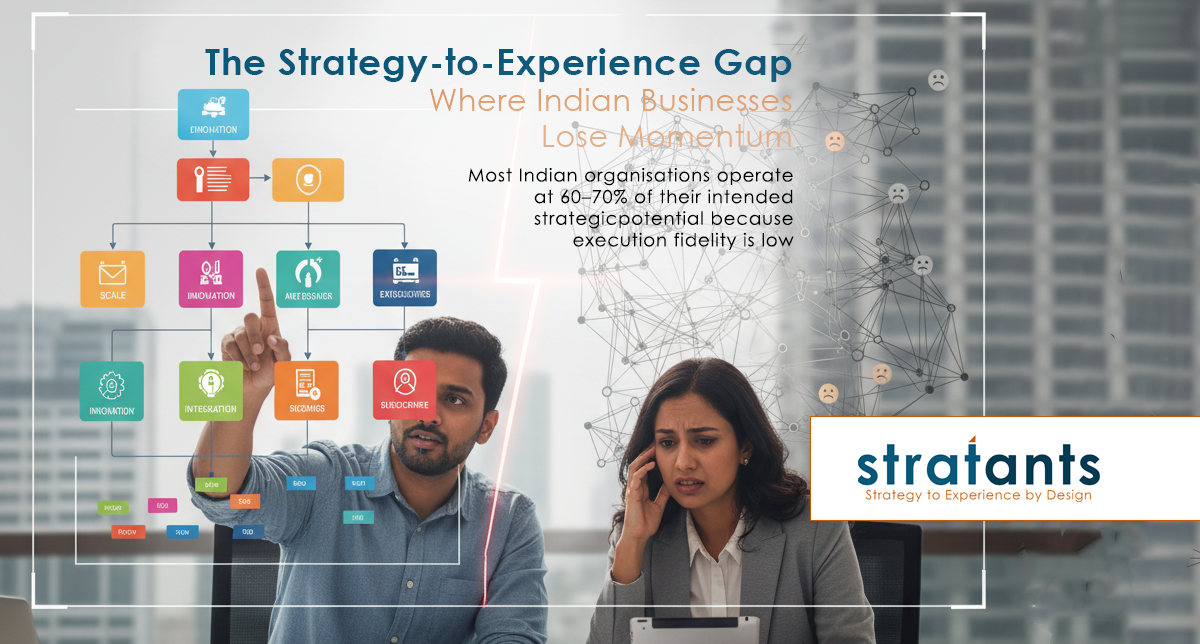
The Strategy-to-Experience Gap: Where Indian Businesses Lose Momentum (And How to Fix It)
Strategy | Leadership | MSME | CX | Org Design | Transformation
Every CXO I meet echoes the same frustration:
“Our strategy makes perfect sense in the boardroom… but something breaks when it reaches teams and customers.”
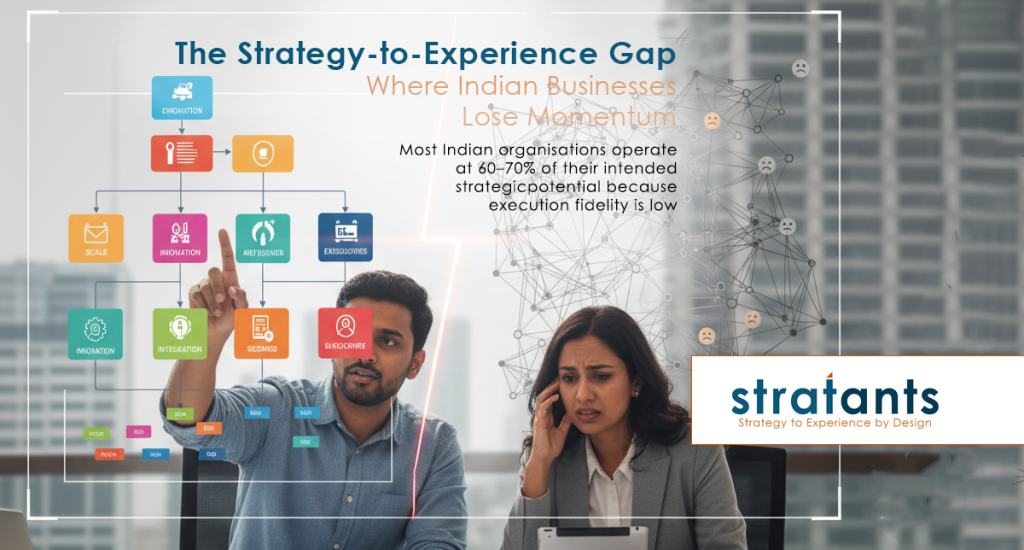
This gap — between strategic intent and lived experience — is one of the biggest, least-discussed barriers to growth in Indian organisations today.
And it’s costing businesses far more than we realise.
Not because leaders lack clarity. Not because teams lack talent. But because the translation system between strategy → teams → customers is broken.
This is what I call the Strategy-to-Experience Gap.
1️⃣ The Strategy Is Clear. The Experience Isn’t.
Most Indian companies do not fail at strategy formulation. They fail at strategy transmission.
A brilliant customer-first strategy means nothing if:
- frontline teams don’t understand the “why”
- middle managers are stuck firefighting
- KPIs reward the opposite behaviours
- tech stacks are disconnected
- customers experience inconsistency across touchpoints
This is why companies often see the same pattern:
Great strategy → Poor experience → Customer frustration → Leadership confusion.
2️⃣ What Indian Businesses Commonly Miss
Across sectors — manufacturing, healthcare, retail, SaaS, logistics — the same failure points repeat:
A) Misaligned KPIs
Leadership says “customer-centricity,” but teams are rewarded for speed, cost-cutting, or quantity.
B) Communication Loss in the Middle Layer
Messages cascade down multiple layers — each time losing clarity, urgency, or meaning.
C) Capability Gaps
Teams are asked to execute strategies they were never trained for.
D) Siloed Systems
Tech investments don’t talk to each other, so data, decisions and actions stay fragmented.
E) Cultural Resistance
Even simple changes face pushback because the purpose behind them wasn’t understood.
In short: strategy travels, but clarity doesn’t.
3️⃣ When Strategy Leaks, Customers Feel It First
Most customer complaints are not actually customer issues. They are internal alignment issues leaking outward.
Examples:
- Delayed delivery? → Ops & logistics misalignment.
- Confusing communication? → Brand & service mismatch.
- Repetitive queries? → CRM + product + frontline disconnect.
- Lack of empathy? → KPIs that reward speed, not understanding.
The customer only sees the symptoms. Inside the organisation lies the cause.
4️⃣ The Hidden Cost of the Strategy-Experience Gap
The impact is not small — it’s structural.
- Lost trust
- High churn
- Lower morale
- Wasted tech investments
- Repeated rework
- Slow decisions
- Fragmented customer journeys
Most Indian organisations operate at 60–70% of their intended strategic potential because execution fidelity is low.
Imagine the competitive advantage of simply closing this gap by 10–20%.
5️⃣ What High-Performing Organisations Do Differently
Across global and Indian success stories, one pattern stands out:
They design how strategy will be experienced as carefully as the strategy itself.
That includes:
✔ Clarity Systems
Not just communication — shared language, shared rituals, shared dashboards.
✔ Customer-Backwards Thinking
Every strategic priority is traced to a visible customer moment.
✔ Capability Before Complexity
Before new tools or processes, they build skills and confidence.
✔ Cross-Functional Rhythm
Teams don’t work in silos; they work in loops.
✔ Experience KPIs
Trust, empathy, emotional friction — not only speed or productivity.
These organisations don’t “execute strategy.” They design experiences that deliver the strategy.
6️⃣ Closing the Gap: A Strategic Design Lens
This is where Strategic Design becomes non-negotiable. Not design as aesthetics — but design as the structured practice of shaping how people experience a strategy.
A strategy becomes real only when:
- the customer feels it
- the employee lives it
- the system enables it
- the culture supports it
- the leadership reinforces it
Anything short of this is a document, not a direction.
7️⃣ Where Stratants Comes In
At Stratants, this is our core work.
We help organisations bridge the space where most strategies fail — the space between intent and experience.
Using our ANTS Framework (Align → Navigate → Transform → Sustain), we work with leaders to:
ALIGN
Strategic clarity with team understanding and customer reality.
NAVIGATE
Complex change with simple, human-centric structures.
TRANSFORM
Internal processes, touchpoints, and culture so the strategy is felt at every level.
SUSTAIN
Momentum, behaviours, and consistency through guided advisory support.
Because strategy shapes design. And design shapes human experience.
And in today’s Indian business landscape, the organisations that win will not be the ones with the loudest strategy — but the ones whose strategy is felt, lived, and experienced across every moment.
#StrategyToExperience #BusinessStrategy #OrganisationalAlignment #CustomerExperience #StrategicDesign #MSMEIndia #Leadership #Transformation #CXStrategy #BusinessGrowth #ChangeManagement #WorkforceAlignment #Stratants #StrategyByDesign #ExperienceDesign
Visit Linkedin –
https://www.linkedin.com/company/stratants