How One Emotion Quietly Shapes Culture — And What Leaders Usually Miss
Strategy · Behaviour · Human Experience By Stratants — an independent strategy & experience advisory studio exploring how vision, behaviour, and human experience shape meaningful growth.
Every organisation speaks about strategy. But very few speak about the quiet emotional undercurrents that shape how people behave, collaborate, and make decisions every day.
Here’s a simple story — something as ordinary as a daily status meeting — to show how a single emotion can quietly turn into organisational culture.
1. The Meeting That Looked Normal — But Didn’t Feel Normal
It’s 9:30 AM. A team gathers for their daily stand-up.
Nothing unusual on the surface. But as people walk in, almost everyone feels the same small emotion:
👉 Nervousness.
Someone thinks: “I hope I don’t get asked something I can’t answer.”
Another adjusts their posture. Someone else rehearses their update.
This is not documented anywhere in the agenda. But it’s the real experience that shapes the moment.
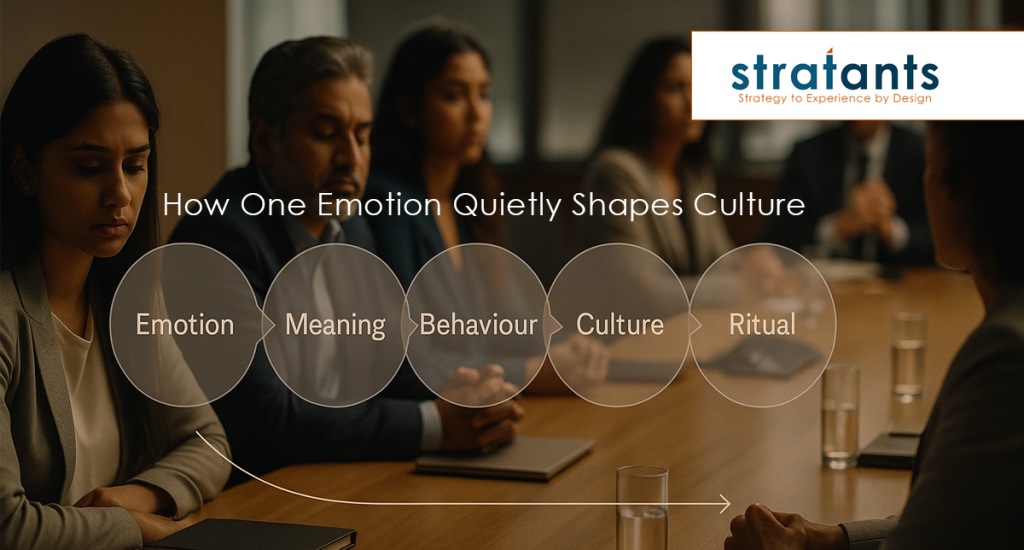
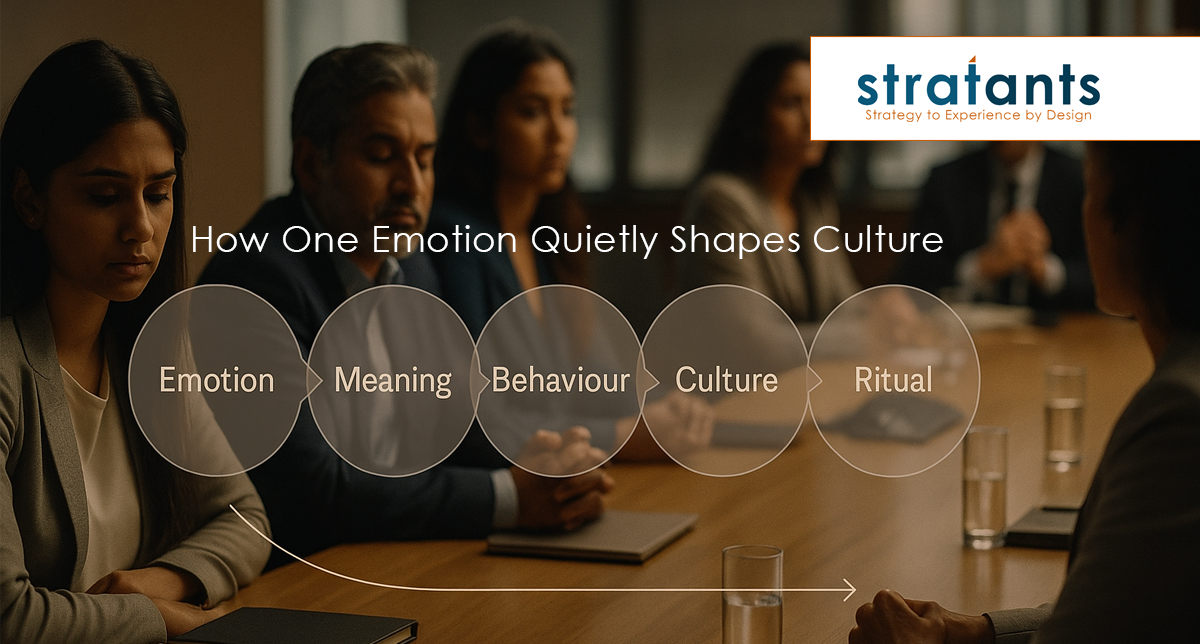
2. Emotion Turns Into Meaning — Quietly
Humans always try to explain their feelings.
So when someone feels nervous, the mind asks: “Why do I feel this way?”
The quiet answer becomes:
👉 “If I make a mistake, I might be judged.”
Now, the meeting carries a meaning — not the meaning written by leadership, but the meaning constructed by the team.
3. Meaning Turns Into Behaviour
Because of that meaning, behaviour changes:
- eye contact is avoided
- updates are rushed
- problems are hidden
- only “safe” information is shared
People begin to perform confidence instead of expressing clarity.
It’s not a communication problem. It’s a meaning problem.
4. Behaviour Turns Into Culture
When several people repeat the same emotion and behaviour, something bigger forms:
👉 a silent cultural rule.
Without being said aloud, people start believing:
- “Don’t show weakness.”
- “Speed matters more than clarity.”
- “Mistakes must stay hidden.”
No policy states this. No leader intends this. Yet the culture absorbs it.
Culture is what people repeat — not what leaders declare.
5. And When It Repeats Every Day, It Becomes Ritual
If the meeting continues like this:
- nervous at the start
- guarded during updates
- relieved at the end
Then the meeting becomes more than a meeting.
It becomes a ritual of self-protection.
A space meant for progress becomes a stage for performance.
This is how experience silently rewrites the organisation’s emotional architecture.
How Leaders Can Shift This — Subtly and Powerfully
Culture doesn’t change through announcements. It changes through everyday human signals.
Here are small shifts that make a deep difference:
1. Start with support, not status
Instead of: “Is it done?” Try: “Is there anything that will make this easier?”
Support is the strongest antidote to fear.
2. Acknowledge the emotional climate
A gentle: “Let’s slow down and give everyone space” can reset the room instantly.
Leaders set the emotional temperature.
3. Celebrate clarity, not perfection
When someone says “I’m stuck,” respond with: “Thank you for being clear.”
This changes the rule from: “Don’t show weakness” → to → “Honesty is welcomed.”
4. Model imperfection
When leaders own small mistakes, teams learn that vulnerability is safe.
5. Shift meetings from performance to meaning
Replace rushed updates with: “What’s one thing that will truly move us forward today?”
Meetings become thinking spaces again.
The Stratants Reflection
At Stratants, we explore how vision, behaviour, and human experience shape meaningful organisational movement.
This story is a reminder that strategy does not fail in documents — it fails in the small moments people live every day:
- a tone in a meeting
- a hesitation to speak
- a nervous glance
- an unspoken rule
- a repeated behaviour
When leaders learn to sense these moments, they access the deepest layer of organisational alignment — the layer where culture is formed and where meaningful growth begins.
A Question to Leave You With
If you observed your team’s everyday emotions closely, what culture might you discover hiding beneath the surface?
Visit – www.stratants.com
#OrganisationalBehaviour #LeadershipInsight #HumanExperience #WorkplaceCulture #BehaviouralStrategy #EmotionalIntelligence #PeopleDynamics #ExperienceThinking #CultureByDesign #Stratants #StrategyToExperience #LeadershipReflection #FutureOfWork #TeamDynamics #OrganisationalAlignment