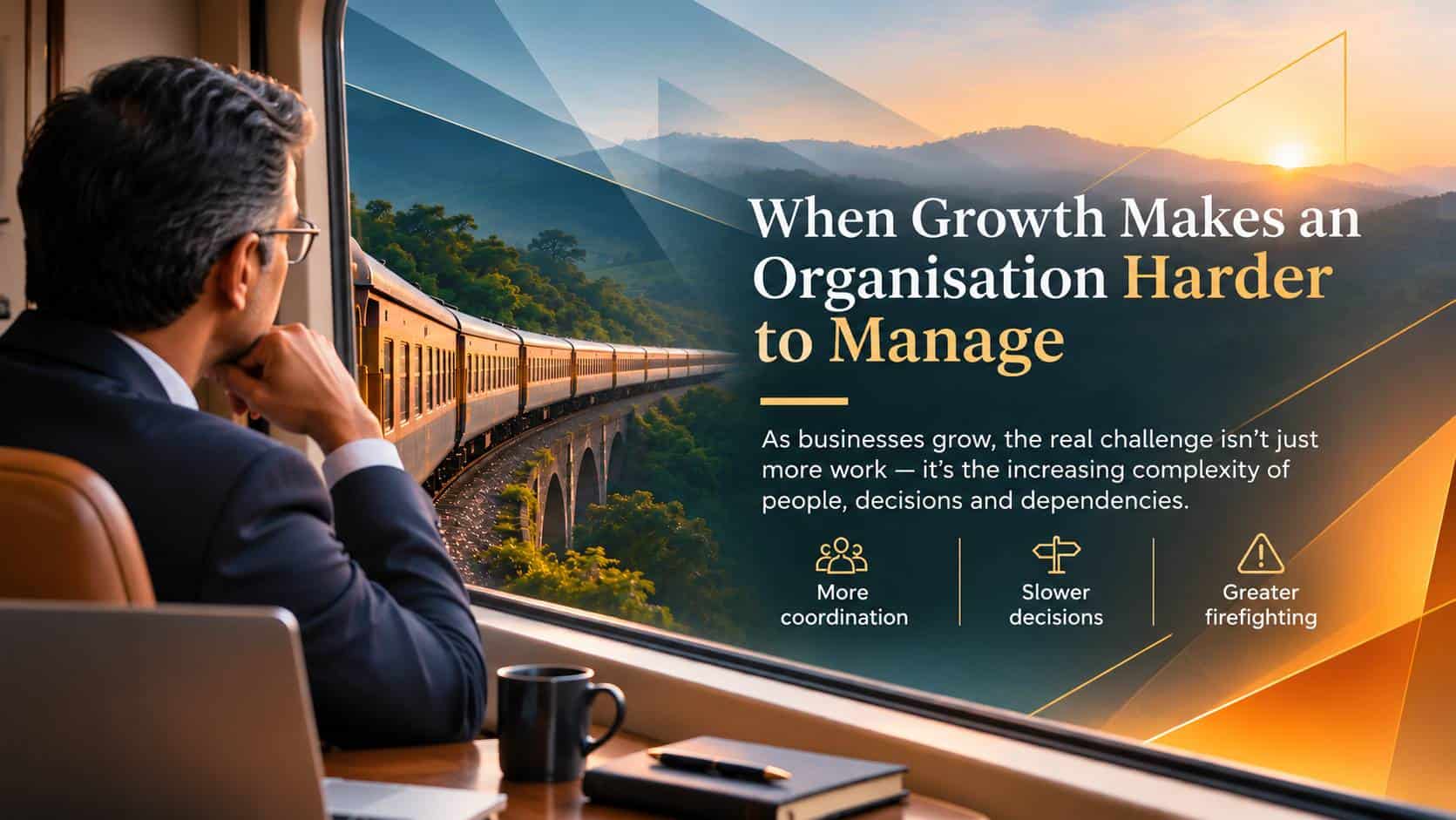
As organisations grow, complexity becomes part of everyday work. But are we spending too much energy managing the organisation and too little improving what it is capable of achieving?
Imagine travelling inside one coach of a long train.
You experience its movement, hear its sounds and deal with whatever happens around you. You are occupied with keeping things moving within your coach.
But you cannot see the entire train. You may not know what is happening in other coaches, how they are connected or where the friction originates.
You are simply part of a much larger movement.
This is not very different from how people experience organisations.
Inside their respective functions, teams and responsibilities, people deal with everyday demands, resolve issues, coordinate with others and keep things moving.
Some become exceptionally good at firefighting. Others spend much of their time following up, seeking approvals and resolving issues that seem to return in different forms.
Over time, this becomes normal. Some even begin to believe that these daily challenges are simply what they are paid to handle.
But there is a distinction between the work that creates value and the effort required to keep the organisation functioning.
What if an increasing proportion of organisational energy is being spent compensating for the way the organisation itself works?
The growing cost of keeping things moving
This is not merely an observation from within organisations. Recent research offers some interesting evidence.
Deloitte's 2025 Global Human Capital Trends report found that managers spend 21% of their working time solving today's problems and another 16% on administrative tasks. Together, that is 37% of their time. Only 15% is spent planning and strategising for the future, and 13% developing their people. The research draws on nearly 13,000 business and HR leaders across 93 countries.Microsoft's 2025 Work Trend Index presents another perspective. Its survey of 31,000 knowledge workers across 31 markets found that 48% of employees and 52% of leaders describe their work as chaotic and fragmented. Its productivity telemetry also found that employees using Microsoft 365 are interrupted, on average, every two minutes by meetings, emails or notifications.These findings do not suggest that every interruption or administrative activity is avoidable. But they raise an important question: how much organisational capacity is being consumed by coordination, recurring problems and the effort of keeping work connected?
Perhaps we have become so accustomed to managing this complexity that we no longer question it.
The organisation behind the experience
During my years working in experience design, I began noticing something that gradually changed the way I looked at organisations.
The experience delivered to a customer is rarely created by the team or function directly responsible for that interaction.
A delayed response may originate in an internal approval process. An inconsistent service experience may reflect fragmented information. A difficult customer journey may have roots in systems designed independently and never brought together effectively.
The customer experiences the outcome, not the internal structure that produced it.
I began seeing a contradiction. The experience an organisation was delivering sometimes told a different story from the one it believed about itself.
Customer feedback, complaints and recurring friction were signals of something happening much deeper within the organisation.
Capgemini Research Institute's 2025 report, Unleashing the Value of Customer Service, found that 74% of surveyed executives identified poor interdepartmental coordination as a major barrier to improving customer service. The study surveyed 1,002 executives from large organisations across 10 industries.
This reinforced an important observation: customer experience is not simply a front-end responsibility. It is shaped by the relationships, information and decisions operating across the organisation.
Improving the visible experience without understanding the conditions creating it can only take us so far.
When symptoms become normal
As organisations grow, people often develop ways to work around internal difficulties.
An approval that takes several days becomes routine. Employees maintain parallel spreadsheets because the official system does not provide what they need. Departments depend on informal communication because established processes do not connect them effectively.
Workarounds emerge. Individual relationships compensate for structural gaps. Managers become accustomed to resolving issues that repeatedly surface.
The organisation becomes increasingly efficient at coping with its own difficulties.
But coping is not necessarily improving.
The same problem may appear in different forms across departments because its underlying conditions remain unchanged.
Adding people, processes, technology or management layers may address individual symptoms. But unless we understand the relationships creating those symptoms, the organisation may simply add more complexity to an already complex environment.
The need for a different lens
These observations gradually changed the direction of my own professional thinking.
My experience in design and customer experience had taught me to look beyond what people see and interact with. But I increasingly wanted to understand what was shaping those experiences within the organisation.
I began examining how responsibilities were distributed, how information travelled, how decisions were made and how different functions depended on one another.
Systems thinking offered a way to explore these relationships.
A problem in one function could have its origins in another. A decision made to improve one area could create unintended consequences elsewhere. A process might appear efficient in isolation while slowing down the organisation as a whole.
I started creating independent analytical reports to understand organisational structures, dependencies and recurring patterns. Initially, these were simply part of my own exploration.
Gradually, the pieces began connecting.
As my chapter at IBM came to a close, I was increasingly certain about the direction I wanted to pursue. I wanted to move beyond understanding the experiences organisations create and spend more time understanding the systems that shape them.
I realised that this required a distinct lens, one that examined the organisation as an interconnected ecosystem rather than a collection of independent functions.
That realisation became the foundation for Stratants and its Strategic Systems Advisory approach, SAGE.
Before deciding what to change
Growth is not the problem. Nor is complexity something an organisation can or should eliminate entirely.
The challenge is to distinguish between complexity that enables growth and complexity that creates unnecessary friction.
For business leaders, perhaps the more useful questions are not simply about managing more work.
Are recurring problems being addressed at their source, or are people becoming increasingly efficient at working around them?
Are different functions contributing to organisational outcomes, or primarily optimising their own responsibilities?
Are leaders spending enough time shaping the future, or becoming indispensable to everyday operations?
A growing business needs more than additional resources to sustain its progress. It needs an organisation capable of evolving with its ambitions.
Sometimes, the most important step is to step outside the individual compartments, look at the entire train and understand how everything is connected.
Because meaningful improvement begins not with treating every visible problem, but with understanding the system that keeps producing it.
At Stratants, we look beyond visible business problems to understand the relationships, dependencies and organisational conditions shaping their outcomes. This is the foundation of our Strategic Systems Advisory approach.
*** Image is created using OpenAI