SAGE Advisory helps leaders
understand the system
behind visible problems.
We help leaders understand the system behind visible problems, uncover what shapes organisational outcomes, and determine what needs to change.
- SAGE looks at the relationships that shape how an organisation actually works — not just how it is intended to work.
- SAGE does not prescribe a solution before understanding the situation.
- Every engagement is run personally by Avyaktaha — no junior team, no handoffs.
A discipline for understanding organisations
before deciding what to change.
Most organisations facing growth, transformation or rising complexity have a clear sense that something is not working — but a less clear sense of what, precisely, is causing it. The visible problem is often not the source of the difficulty. What is shaping outcomes tends to sit in the relationships between decisions, people, priorities and structure.
SAGE Advisory is a systematic approach to making those relationships visible — so that leaders can understand what is actually happening before committing to what needs to change. That clarity is the foundation of decisions that hold.
SAGE is sector-agnostic as an approach. It is relevant wherever consequential decisions depend on understanding the organisation's current reality — not just its stated strategy.
Our Vision
To help leaders realise their aspirations for their organisations through clarity, insight and meaningful change.
Surface. Articulate.
Guide. Embed.
Four orientations that describe how SAGE Advisory approaches an engagement — each one informing the next.
Surface
Understand the organisation's context — what is visible from outside, what is experienced from within — before drawing any conclusions about what needs to change.
Articulate
Develop clarity about the situation — making visible what has been sensed but not yet named, and establishing a shared basis for decisions that follow.
Guide
Explore possible changes with leadership and stakeholders — working through what the situation means and what, if anything, needs to be different.
Embed
Support agreed action and learning where included in scope — so the clarity that has been reached can take hold in how the organisation actually works.
Our Mission
To help leaders see beyond visible problems, understand the systems shaping their organisations, question underlying assumptions, and make informed decisions that lead to meaningful and sustainable change.
Before deciding what to change,
understand what is shaping the situation.
Leaders often approach an advisory engagement with a defined need: a growth strategy, an organisational redesign, operational improvement or a transformation initiative.
SAGE begins by looking beyond the stated requirement to understand the situation in its wider organisational context. Rather than treating strategy, people, processes and technology as independent concerns, we examine how their interactions may influence outcomes.
This creates a stronger basis for leadership decisions: not simply choosing what to do next, but developing a clearer understanding of what may need to change and why.
Three complementary orientations
that shape how SAGE works.
SAGE Systems, SAGE Principles and SAGE OpenLabs are not separate services. They describe the intellectual orientation that guides every engagement — how SAGE sees, questions and learns.
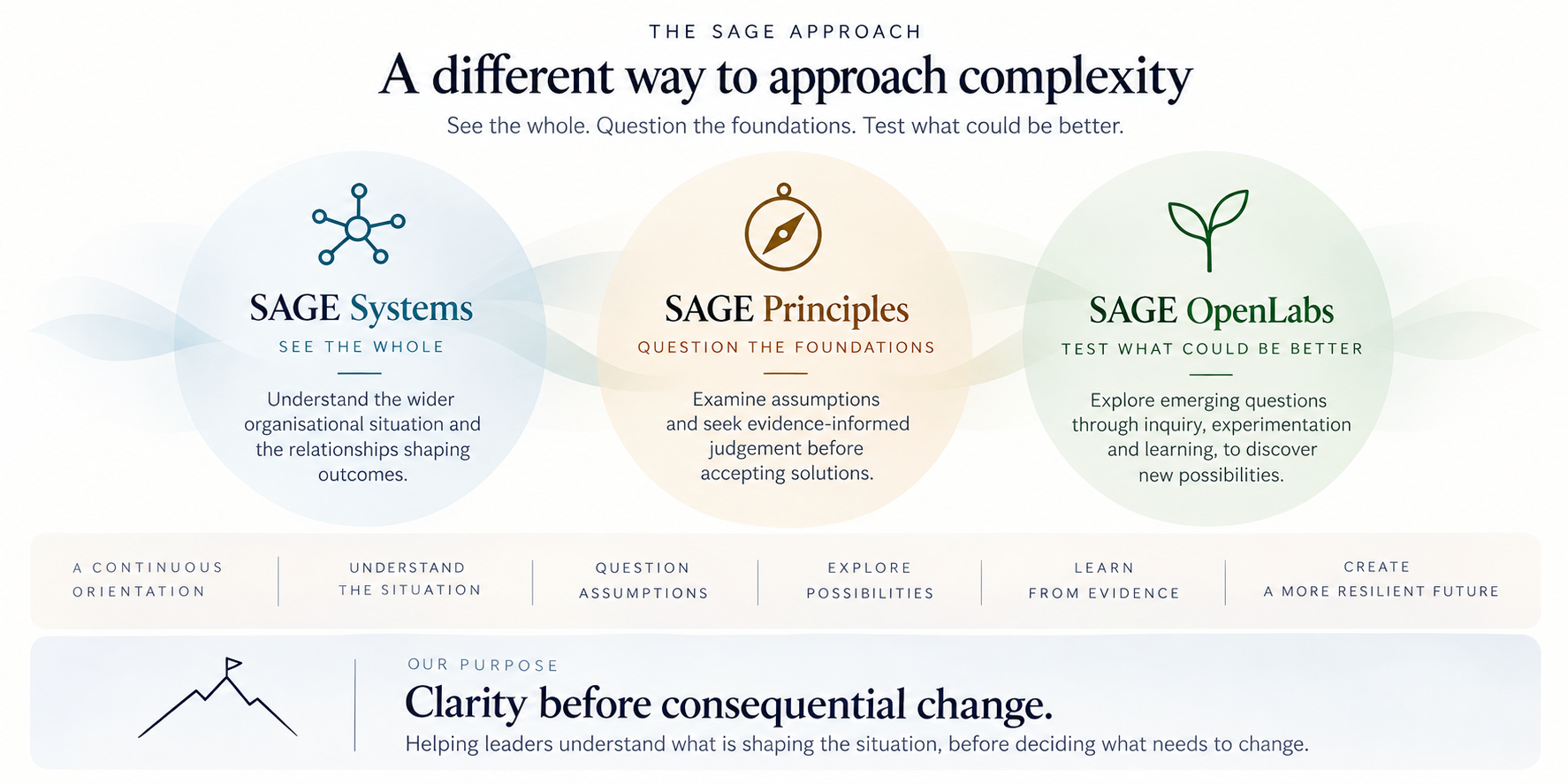
See the whole.
Organisations rarely operate as neatly separated functions. Strategy, people, processes, technology and leadership decisions interact, shaping how the organisation performs and responds to change.
SAGE Systems brings a systems perspective to organisational challenges. It helps leaders look beyond isolated symptoms and consider the wider relationships influencing outcomes.
The objective is to build a clearer understanding of the situation before deciding what needs to change.
Question the foundations.
Before accepting a problem as it has been presented, we examine the assumptions, expectations and beliefs shaping how it is understood.
SAGE Principles reflect a commitment to thoughtful inquiry, evidence-informed judgement and a willingness to question familiar explanations.
We distinguish what is known from what is assumed, remain open to alternative interpretations and seek clarity before committing to consequential action.
Test what could be better.
Some organisational challenges cannot be resolved through analysis alone. New possibilities need to be explored, assumptions tested and outcomes observed.
SAGE OpenLabs represents our commitment to inquiry, experimentation and learning. It creates space to investigate emerging questions, explore alternative approaches and examine what may lead to better organisational outcomes.
The emphasis is on learning through disciplined exploration rather than assuming the first plausible answer is necessarily the right one.
Together, these orientations express a broad intellectual progression:
This is a description of how SAGE thinks and works — not a published diagnostic sequence, and not a replacement for the SAGE advisory method: Surface. Articulate. Guide. Embed.
The kinds of situations
SAGE Advisory is built for.
These are not isolated symptoms. They are the kinds of organisational situations where something important is not working as it should — and where the cause is rarely where it appears to be.
Growth is creating new friction
The organisation has grown — but coordination has become harder, not easier. More handoffs, slower decisions, more effort for diminishing return.
The same problems keep returning
Recurring difficulties that resist repeated interventions — a signal that the underlying cause sits in a different part of the system than where attention has been directed.
Strategy isn't translating to action
Leadership has a clear direction. But what is actually happening on the ground — in teams, in decisions, in day-to-day priorities — tells a different story.
Decisions are getting harder
As the organisation has expanded, the decisions that used to be straightforward now take longer, involve more people, and still feel uncertain when they're made.
What the market sees doesn't match the reality
There is a gap between how the organisation understands itself and how it is read from outside — by customers, by the market, by the people it is trying to reach.
An inflection point with real consequences
A moment where the decisions made in the next period will have lasting consequences — and where getting a clear read on the current situation matters before committing to what comes next.
Leaders at a point
of consequential change.
SAGE is most useful when the decisions ahead carry real weight — and when understanding the current situation clearly matters before committing to what comes next.
Organisations where growth has introduced new coordination challenges, decision delays or cross-functional friction that existing ways of working weren't designed to handle.
Situations where the same difficulty persists despite repeated interventions — usually a sign that the underlying cause is in a different part of the system.
Before a significant restructure, investment, leadership change or pivot — when clarity about what is shaping current outcomes matters before committing to new ones.
When the consequences of a decision are significant enough that getting the diagnosis right is worth the time it takes to do it properly.
SAGE Advisory is sector-agnostic. The approach applies wherever leadership and organisational complexity intersect — it is not limited to any industry, size or geography.
Every SAGE engagement is run directly by Avyaktaha.
No junior team. No handoffs. No account managers.
Avyaktaha has spent two decades working across design, customer experience, business transformation and organisational strategy inside large enterprises. That cross-disciplinary path — understanding people through design, organisations through transformation work, and the connections between them through systems thinking — is what the SAGE methodology grew out of.
The name Avyaktaha means the invisible, articulated — the most honest description of what SAGE does.
Before deciding what to change,
understand what is shaping the outcome.
An initial conversation explores the business context, the challenges ahead and the decisions that matter most right now. There is no pitch, no proposal, and no commitment implied.
Start a conversation with SAGE Advisory