Reflections are personal observations from the field—moments that challenged the way I think about organisations, leadership, and decision-making. They don’t offer definitive answers, but they invite us to see familiar problems differently.
What if the meeting wasn’t the problem? What if it was trying to solve one?
[time: 6 min read]
“This meeting could have been an email.”
If I had ₹100 every time someone said that after a meeting, I probably wouldn’t need to work anymore.
We’ve all been there.
Someone schedules a one-hour meeting.
Half the participants join five minutes late.
One person is still searching for the Unmute button.
Someone shares the wrong screen.
Another says, “Can everyone see my presentation?” even though it’s still loading.
Then comes the classic line:
“Let’s wait for a couple more people before we begin.”
Fifteen minutes later, the meeting finally starts.
Forty-five minutes after that…
Someone smiles and says,
“This has been a good discussion. Let’s schedule another meeting to take this forward.”
Congratulations.
We’ve just spent an hour deciding that another hour is required.
It’s funny because we’ve all lived through it.
But over the years, I’ve started wondering if we’ve been laughing at the wrong thing.
A Meeting I Couldn’t Stop Thinking About
A few months ago, I was sitting in a leadership review with a client.
Everything looked impressive.
The dashboard was beautifully designed.
Revenue trends.
Customer satisfaction scores.
Marketing performance.
Operational metrics.
Someone had even generated an AI summary before the meeting began.
On paper, the organisation seemed to know everything.
The discussion went on for nearly an hour.
People debated numbers.
Compared trends.
Asked questions.
Suggested actions.
Then the CEO quietly leaned back in his chair and asked,
“I understand what the numbers are saying… but what are they actually trying to tell us?”
The room went silent.
Not because anyone lacked information.
Everyone had the same dashboard.
Everyone had seen the same reports.
The silence came because the conversation had shifted.
We were no longer discussing data.
We were trying to understand what the data meant.
That moment stayed with me long after the meeting ended.
Maybe Meetings Aren’t About Information
We often assume meetings exist because information hasn’t reached people.
Increasingly, I think the opposite is true.
Most organisations already have plenty of information.
Dashboards.
Reports.
Emails.
Spreadsheets.
Slack messages.
WhatsApp groups.
Microsoft Teams.
AI-generated summaries.
The modern workplace isn’t suffering from a shortage of information.
It’s suffering from an abundance of it.
And abundance creates a different problem.
Not access.
Interpretation.
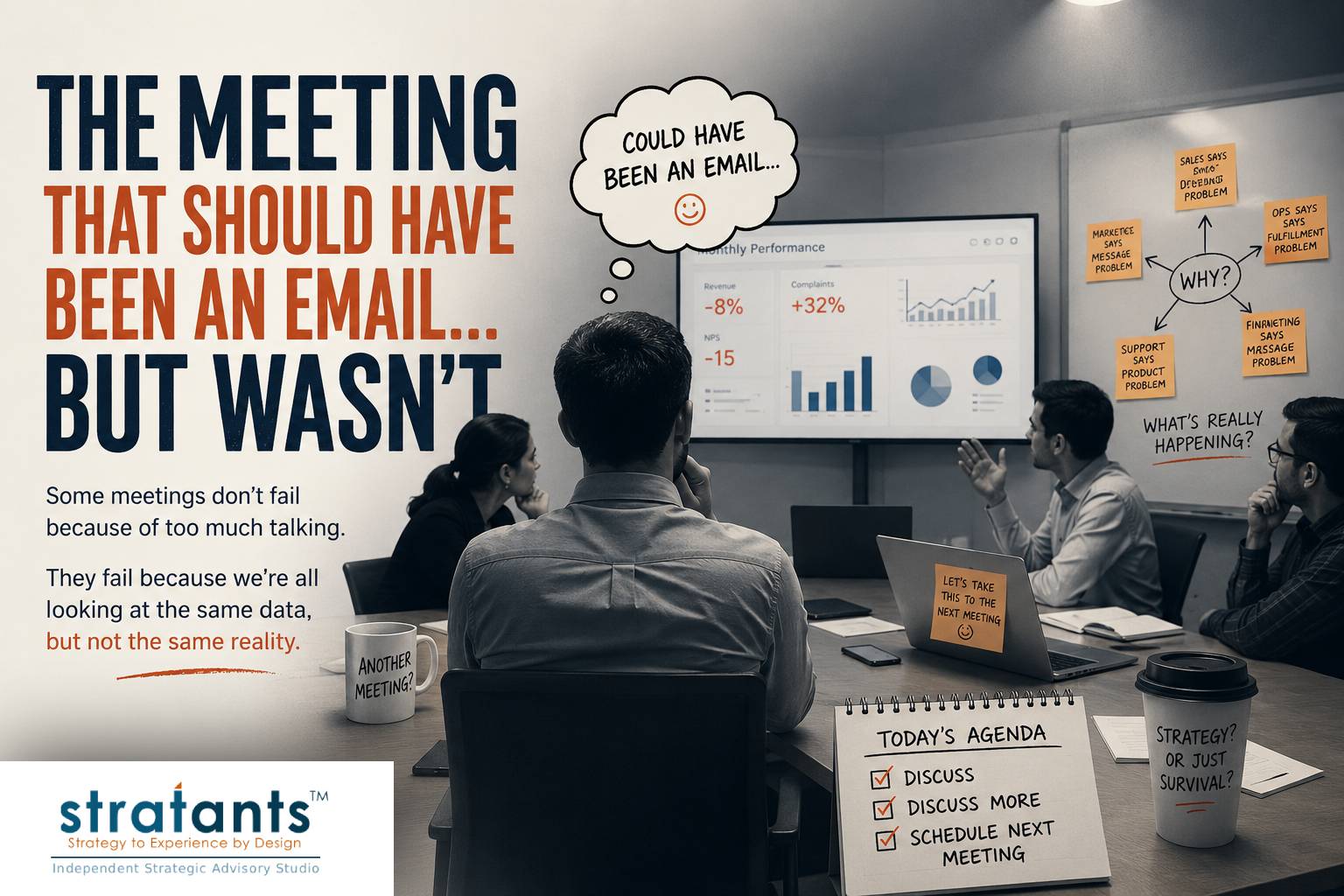
Everyone Saw the Same Dashboard…
Imagine this.
The monthly business review begins.
Sales are down by 8%.
Customer complaints have increased.
Marketing says demand is soft.
Operations says fulfilment is the issue.
Finance says margins need protecting.
Customer Support says the product isn’t the real problem.
Nobody is lying.
Nobody is hiding data.
Everyone is looking at exactly the same numbers.
Yet everyone leaves the room with a different explanation.
The dashboard answered the question,
“What happened?”
It couldn’t answer,
“Why did it happen?”
Or perhaps more importantly,
“What should we do next?”
Those answers don’t come from dashboards.
They emerge through conversation.
AI Can Summarise.
But It Can’t Align.
Today’s AI tools are extraordinary.
They can summarise meetings.
Highlight patterns.
Generate reports.
Predict trends.
Even suggest possible actions.
That’s remarkable.
But there’s something AI cannot do for a leadership team.
It cannot create shared understanding.
It cannot resolve conflicting assumptions between departments.
It cannot replace trust.
It cannot replace judgment.
And it certainly cannot replace the uncomfortable but necessary conversations that lead to better decisions.
Technology can accelerate information.
Only people can align meaning.
The Real Purpose of Some Meetings
This made me rethink something.
Perhaps some meetings aren’t really about making decisions.
They’re about helping people see the same reality.
When Sales, Marketing, Operations and Finance each tell different stories about the same organisation, no amount of email communication will solve that.
A meeting becomes valuable not because information is exchanged.
It becomes valuable because interpretations are challenged.
Assumptions are questioned.
Blind spots become visible.
People gradually begin to construct a shared understanding of what’s really happening.
That’s something an email struggles to achieve.
So Why Do Some Meetings Still Feel Like a Waste?
Because not every meeting deserves to exist.
Some genuinely should have been an email.
Status updates.
Routine approvals.
Information broadcasts.
Those belong in an inbox.
But some meetings fail for a different reason.
People arrive without clarity.
Without preparation.
Without a clear question to answer.
Or worse…
Everyone arrives with the intention of defending their department instead of understanding the organisation.
Those meetings rarely create insight.
They simply consume time.
Perhaps We’ve Been Asking the Wrong Question
Instead of asking,
“Could this meeting have been an email?”
Maybe we should ask,
“What uncertainty was this meeting trying to reduce?”
Was it missing information?
Or was it something deeper?
Conflicting interpretations.
Unclear priorities.
Different mental models.
Hidden assumptions.
Because if that’s the real problem, cancelling the meeting won’t solve it.
It will simply postpone the confusion.
A Reflection
As organisations adopt more AI, automate more workflows and generate more reports than ever before, something interesting is happening.
Information is becoming cheaper.
Execution is becoming faster.
Automation is becoming easier.
But shared understanding?
That remains surprisingly rare.
Perhaps the organisations that thrive over the next decade won’t be the ones with the biggest dashboards or the smartest AI.
They’ll be the ones that learn to make sense of complexity together.
Because sometimes…
The meeting wasn’t replacing an email.
It was trying to replace uncertainty.
A Question to Reflect On
The next time someone says,
“This meeting could have been an email.”
Pause for a moment and ask:
Was the meeting really about sharing information… or was it trying to create a shared understanding that an email never could?
You might discover that the meeting wasn’t the problem after all.
It was simply revealing one.