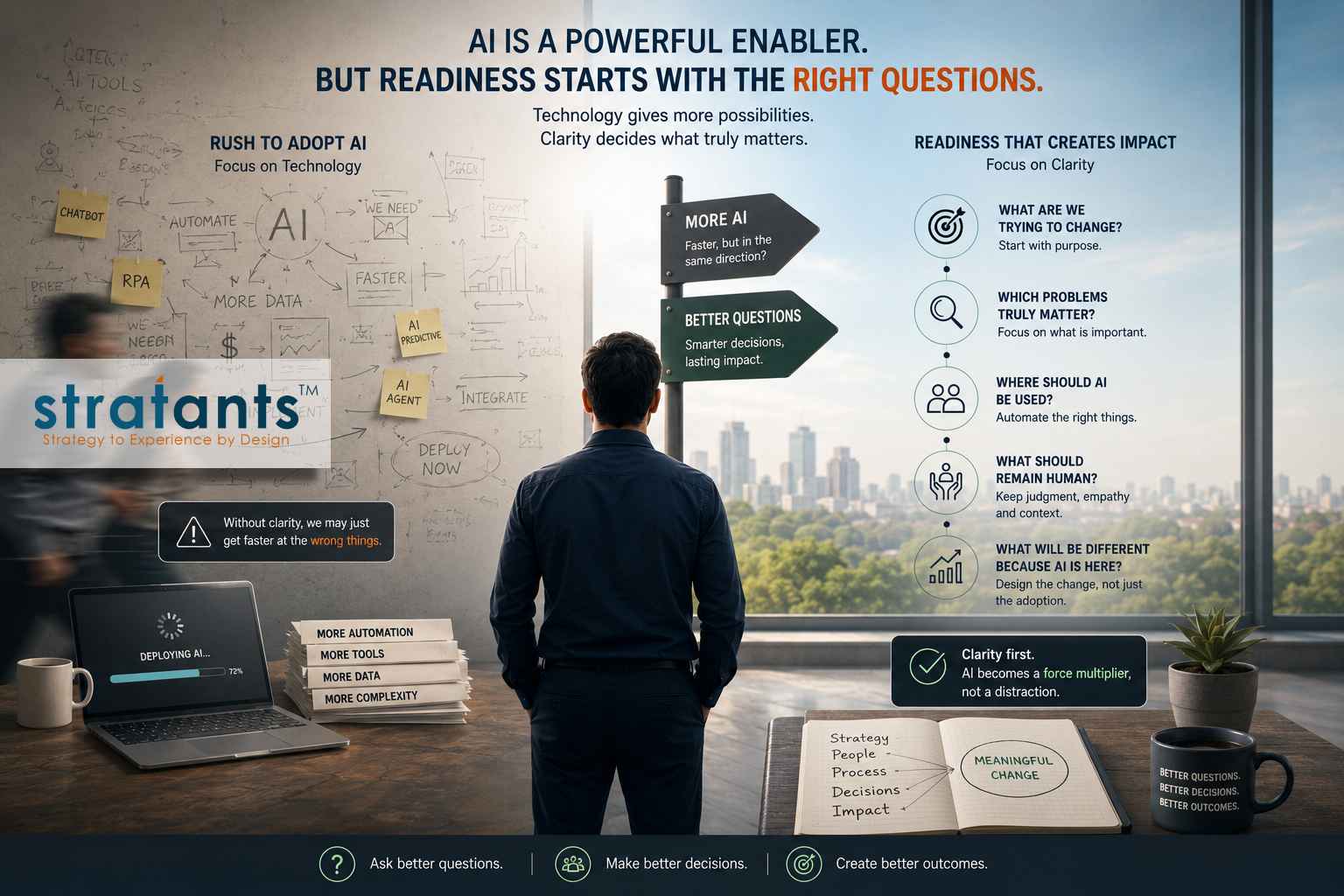
These days, whenever I have a conversation with a CEO, one question seems to come up again and again.
“How do we prepare our organisation for AI?”
The question comes in different forms.
- Should we train our people?
- Should we invest in AI tools?
- Should we automate some of our processes?
- Should we build our own AI capability?
- Should we start experimenting with AI agents?
There is a lot of curiosity around AI. But I also sense some anxiety.
Nobody wants to be the organisation that looks back two years from now and realises that everyone else has moved ahead.
I have been hearing this often enough that it made me stop and think.
What does being AI-ready actually mean?
It is not only about having AI
The question is becoming more real.
PwC’s latest India CEO survey found that 66% of Indian CEOs are more concerned about keeping pace with AI and technology than their global peers. At the same time, 41% said their current AI investments are not enough to meet their goals.
So the concern is real.
And organisations are already moving beyond experiments.
Dabur, for example, is working towards using AI across decision-making, demand forecasting, commercial planning, marketing and other parts of the business.
This is an interesting shift.
AI is slowly moving from a technology conversation to a business conversation.
And that is where things become more interesting.
AI doesn’t enter an empty organisation
An organisation already has its own way of working.
- Processes.
- People.
- Hierarchies.
- Targets.
- Meetings.
- Approvals.
- Incentives.
- Habits.
And, of course, its own problems.
When AI enters the organisation, it doesn’t remove all of these.
It enters into them.
Sometimes it makes them better.
Sometimes it exposes them.
And sometimes it simply makes them faster.
Imagine a company introducing AI into customer support.
- Response time comes down.
- More queries are handled.
- Costs reduce.
- The dashboard looks good.
- Everyone feels positive.
But customers are still unhappy.
Why?
Maybe the real problem was never the response time.
Maybe customers were contacting support because the product itself was confusing.
The organisation has now become very efficient at responding to a problem it never properly understood.
That thought makes me pause.
So what does AI readiness mean?
I don’t think there is one answer.
But perhaps there are three different questions hiding inside it.
- Technology readiness
- Can we use AI?
- Can our data, systems and technology support it?
- Organisational readiness
- Can our people, processes and culture absorb the changes AI will bring?
- And then there is something I think is even more important.
- Decision readiness
- Do we know where AI should be used?
- Where should we automate?
- Where should humans remain involved?
- Which problems are actually worth solving?
- And which problems should we leave alone?
The third question is probably the hardest.
Because technology can give us more possibilities.
It doesn’t automatically tell us which possibility is worth pursuing.
We may be entering an interesting phase
I wrote recently about how execution is becoming increasingly abundant.
The more I think about AI, the more I see the connection.
- AI can generate ideas.
- Analyse information.
- Write.
- Design.
- Code.
- Summarise.
- Predict.
- Automate.
The number of things an organisation can now do is increasing very quickly.
But more possibilities don’t necessarily create better decisions. Sometimes they create more choices. And more choices can create more confusion.
So perhaps the challenge is not simply becoming better at using AI.
Perhaps it is becoming better at deciding where AI should actually be used.
Maybe the first AI question is not about AI
When a CEO asks me,
“How do we make our organisation AI-ready?”
I find myself wanting to ask a few questions before talking about technology.
- What are we trying to change?
- Which problems are actually important?
- Where are we losing time, money or customer trust today?
- What should become automated?
- What should remain human?
- What decisions are we currently struggling to make?
These questions may sound very basic. But perhaps that is the point.
We sometimes rush towards sophisticated technology before becoming clear about the problem.
A small reflection
Maybe being AI-ready is not about having the smartest AI tools.
It is about having enough clarity to know what to do with them.
Because AI can give an organisation more intelligence, more speed and more possibilities.
But it cannot decide what truly matters.
That still requires people.
- Judgment.
- Context.
- Understanding.
And sometimes the courage to say:
“We don’t need AI here.”
Perhaps that is also part of being AI-ready.
Knowing not only where to use AI, but where not to use it.
That may become one of the more important leadership decisions of the next few years.
*** Image generated using OpenAI