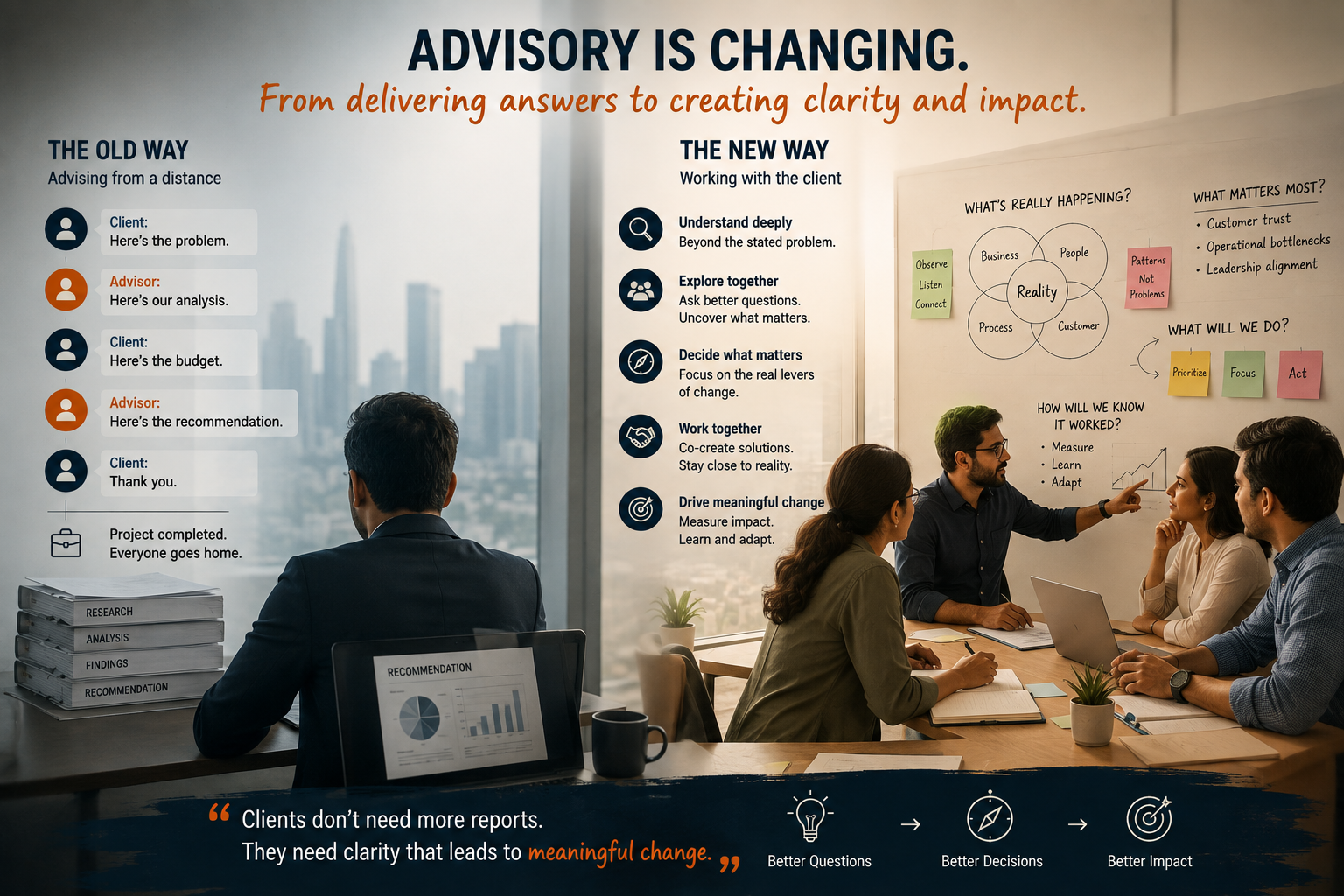
Client: Here’s the problem.
Advisor: Here’s our analysis.
Client: Here’s the budget.
Advisor: Here’s the recommendation.
Client: Thank you.
Project completed.
Everyone goes home.
It sounds almost too simple.
But haven’t many advisory engagements worked something like this?
- The client brings a problem.
- The advisor brings expertise.
- There is a scope.
- There are meetings.
- There is research.
- There is a presentation.
- And finally, there is a recommendation.
Sometimes it works beautifully.
But I wonder if this model is slowly becoming outdated.
The client has changed
Today, a client can do a lot before calling an advisor.
- They can research the market.
- Study competitors.
- Look at benchmarks.
- Analyse their own data.
- Speak to customers.
- Use technology to generate ideas and possible solutions.
- They may already know a lot about the problem.
So the value of an advisor cannot simply be:
“I know something you don’t know.”
The more interesting question is:
“What can I help you see that you are finding difficult to see yourself?”
Imagine a founder saying:
“Our growth has slowed. We need a new strategy.”
- An advisor can immediately start working on the strategy.
- Market research.
- Competitor analysis.
- Customer segments.
- Growth opportunities.
- Roadmap.
- A beautiful presentation follows.
But what if the real problem isn’t strategy?
What if the leadership team is pulling in different directions?
What if the business has outgrown its operating model?
What if customers are leaving because of an experience problem?
What if the founder is trying to solve five problems when only one actually matters?
The advisor can deliver exactly what was requested…
and still miss what the business really needed.
Perhaps the first job of an advisor is not to answer
It is to understand.
- Sometimes that means asking questions that weren’t in the original brief.
- Sometimes it means going deeper into the organisation.
- Sometimes it means looking at the data.
Then talking to people.
Then looking at what is actually happening on the ground.
And sometimes it means telling the client:
“I know this is what you asked us to solve. But I’m not sure this is the problem we should start with.”
That can be an uncomfortable conversation.
But perhaps that is where advisory work starts becoming valuable.
The client doesn’t need another report
- They probably already have enough reports.
- They don’t necessarily need another dashboard either.
- They may not even need another strategy presentation.
- What they need is often much simpler.
- Clarity about what is really happening.
Then:
What matters most?
Then:
What should we do about it?
And finally:
Did anything actually change?
A recent HFS Research study caught my attention.
It found that 76% of enterprise CX clients are open to outcome-based or gainshare pricing, while only 5% of current contracts are actually structured that way.
I find the gap interesting.
It suggests that clients may increasingly want to buy outcomes, while much of the advisory and services industry still sells effort.
- Hours.
- People.
- Deliverables.
- Milestones.
- Reports.
Perhaps the commercial model is slowly catching up with what clients have already started expecting.
So what does the advisor become?
I don’t think the answer is another specialised title.
I think the role is becoming more fluid.
- Part researcher.
- Part thinker.
- Part challenger.
- Part facilitator.
- Sometimes an expert.
Sometimes simply the person who asks the question nobody else in the room was asking.
The advisor may need to move between the business, the people, the data and the reality on the ground.
Because complex problems rarely stay inside one discipline.
- A customer problem may actually be an operational problem.
- An operational problem may be a leadership problem.
- A growth problem may actually be a positioning problem.
- And what looks like a technology problem may simply be a decision problem.
Maybe this is where advisory work is heading.
Not:
Client: Here’s the problem.
Advisor: Here’s the answer.
But something more like:
Client: Here’s what we think the problem is.
Advisor: Let’s understand what is really happening.
Client: What do you see?
Advisor: Here are a few things that don’t seem to fit.
Client: So what should we do?
Advisor: Let’s decide what matters first.
And then…
Let’s work on it together.
Technology is making information, analysis and execution easier to access.
That doesn’t make advisors less relevant.
But it does change where their value comes from.
Perhaps the advisor of the future won’t be the person who brings the most answers into the room.
Perhaps it will be the person who helps the room see the problem differently.
Because sometimes the greatest value an advisor can create is not giving the client a better answer.
It is helping them ask a better question.
And perhaps…
that’s where meaningful change begins.
*** Image generated using OpenAI